recent talks and presentations
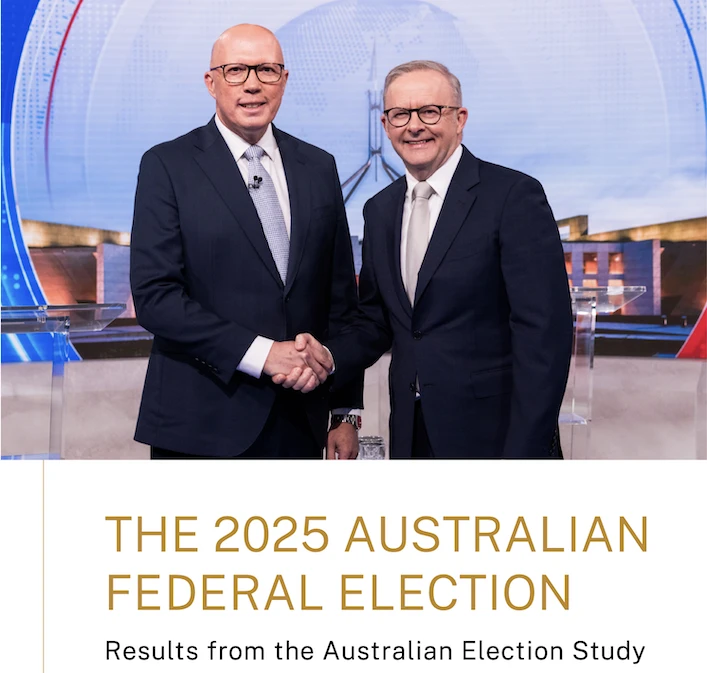
The 2025 Australian Federal Election: Results from the Australian Election Study
Launch of the 2025 Australian Election Study
Parliamentary Library, Parliament House, Canberra
2025-11-26 10:00 AM - 11:00 AM
Sarah Cameron, Ian McAllister, Simon Jackman and Jill Sheppard
The Australian Election Study (AES) is a national survey of Australian voters conducted after each federal election. This talk will present the results from the 2025 AES, focusing on the key findings and implications for Australian politics.

Its Time...for the Liberals to catch up with the electorate on climate
Opinion piece, The Australian
2025-11-14
Simon Jackman
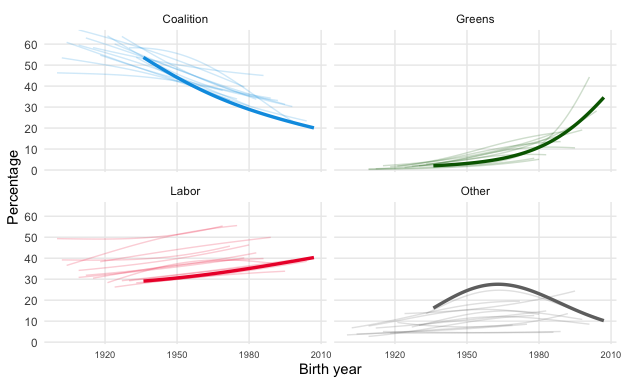
Younger voters overwhelmingly preferred Labor and the Greens in 2025, at levels not seen in the 38-year history of the Australian Election Study. In 2025, Coalition support fell to 21 per cent among Millennials (born 1981-96) and 27 per cent among Gen Z. Greens and teals also polled well in these two generations, their preferences delivering thumping two-party-preferred majorities to Labor: 64-36 among Millennials and 67-33 in Gen Z. Millennials report being more politically animated by climate and the environment in 2025 than any other generation, as is their preference for Labor over the Coalition on climate issues, and among voters nominating climate change or the environment as one of their top two most important issues in the 2025 election, the Coalition won a paltry 10 per cent of first preferences and Labor won the two-party preferred vote by a stupendous margin of 87-13. There is no other issue where the Liberals are so far underwater. at least given the policies they took to the election.
Cementing Labor's majority: generational turnover and the 2025 Australian Federal election
Contribution to Australian Election Study 2025 report
2025-11-10
Simon Jackman
Analysis of the 2025 Australian Election Study confirms what has been building for more than a decade: younger Australians are turning away from the Coalition in unprecedented numbers, defying typical patterns of conservative-leaning maturation in partisanship and ideology over the lifecourse. Millennial support of the Coalition has fallen steadily from 38% in 2016 to 21% in 2025, while Labor's support has risen from 33% to 37%, or 64% in 2PP terms. Precisely as this cohort has transitioned from early adulthood to their 30s and 40s, Millennial support for the Coalition has fallen by almost one-half.
Backfire
Academy of the Social Sciences in Australia Workshop on the 2025 Federal election
Research School of the Social Sciences, Australian National University, Canberra
2025-06-13
Simon Jackman
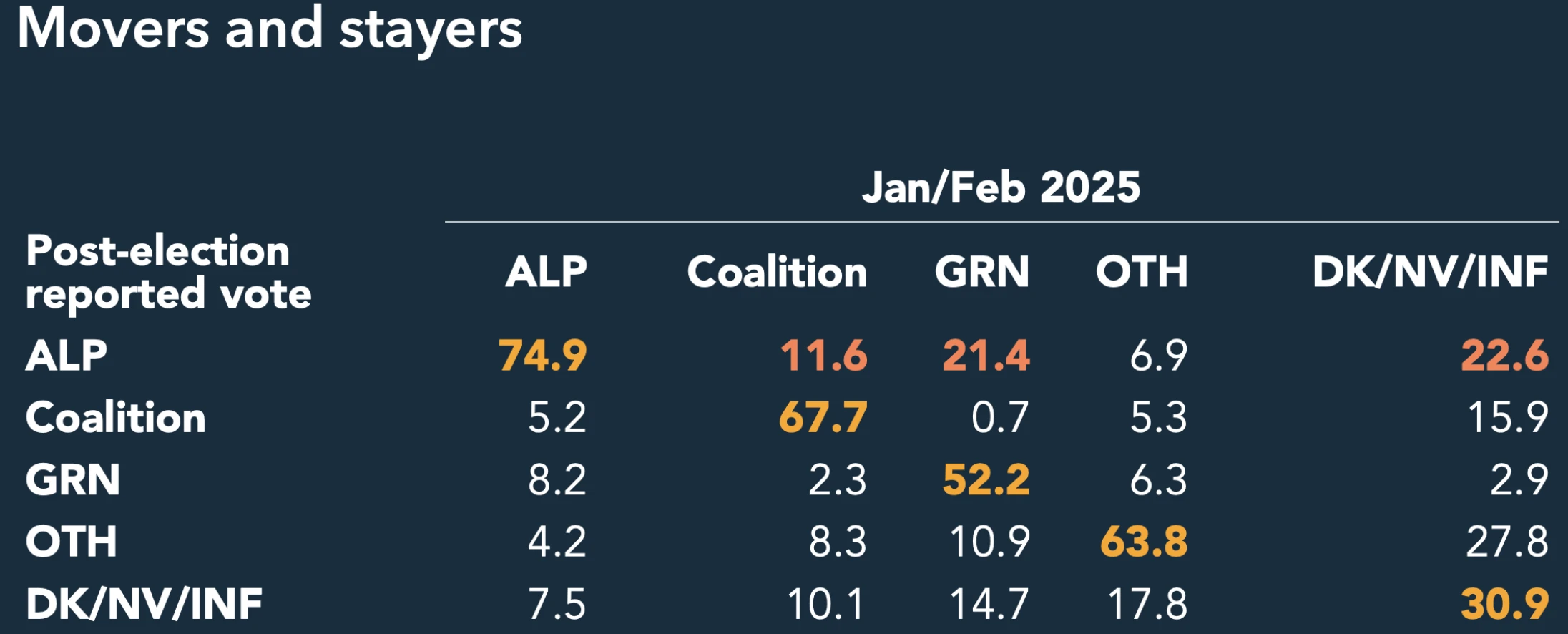
Using a unique, four wave survey, I analyse the drivers of Labor's surge in support in the months leading up to its historic winning margin in the 2025 Federal election. Albanese's net likeability over Dutton grew steadily over the six months leading up to the election, and is a key driver of transitions in voter support to Labor. Separately, Labor did extremely well in converting 21% of Green supporters and 23% Undecideds, comparing Jan/Feb voting intentions and the post-election wave of the survey. Respondents reporting having voted Yes on the Voice were more likely to convert to Labor; this is especially the case among respondents intending to vote for the Coalition in early 2025. 23% of Jan/Feb Coalition supporters who reported having voted "Yes" on the Voice switched to Labor; just 9% of Coalition "No" voters switched. Conversely, "move" vs "stay" rates for Labor supporters are unrelated to the Voice vote.
Estimating mass sentiment from noisy, biased signals: recent Australian elections and the Voice referendum
Seminar, Department of Econometrics and Business Statistics, Monash Business School, Monash University
Monash University Business School, Caulfield, Victoria
2023-10-30 2:00 PM - 3:50 PM
Simon Jackman
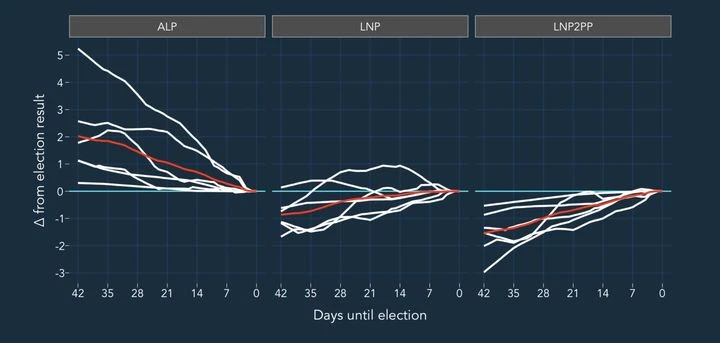
I deploy a class of hidden Markov models to recover the trajectory of latent public opinion from a series of noisy and possibly biased signals: public opinion polls. Example applications include recent Australian federal elections and the current Voice referendum campaign. In addition to recovering both level and trend in mass sentiment, incorporating known election results ex post identifies pollster biases. Pollster biases are a durable characteristic of Australian election polling; calibrating model outputs to adjust for these biases produced accurate forecasts of the 2022 Australian Federal election result. Recent Australian federal elections also reveal a persistent pattern of voter sentiment trending towards the Coalition over the campaign. We also discuss extensions of the model, including switching between volatility regimes and step discontinuities in response to shocks such as leadership switches, scandals and gaffes.
Owning the agenda: using machine learning to track issue salience
Annual Conference, Australian Society for Quantitative Political Science
Australian Catholic University, East Melbourne
2022-12-13 2:00 PM - 3:50 PM
Simon Jackman and Andrea Carson
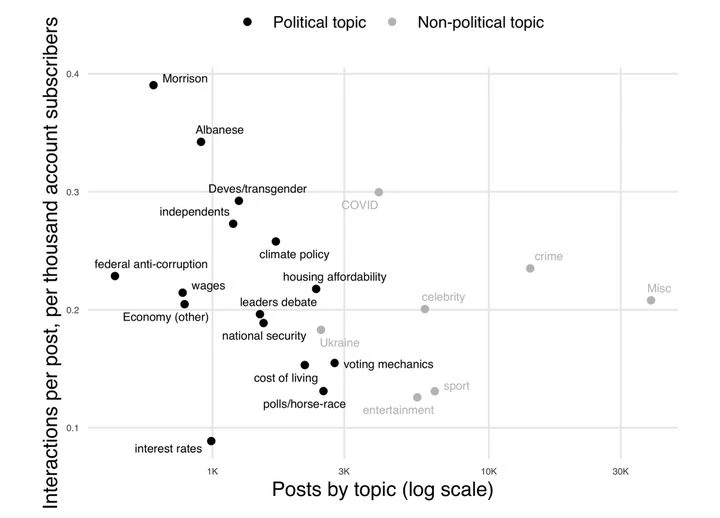
We analyse 325,000 social media posts from parties, candidates, interest groups and media organisations generated ahead of the 2022 Australian federal election. Learning the topics of these posts provides insight into the issues and campaign narratives of the election. Observed changes in topic prevalence over the campaign – and between different publishers – lets us chart the competition among rival campaign frames and for issue ownership. Measures of user interactions with posts (aggregated to topics) further reveal the dynamics of this competition. We use these data to assess the extent to which parties, candidates and media organisation engineer issue salience, or respond to the public’s appetite for issues and frames revealed in social media interactions. Our analysis of the social media posts goes well beyond the bag-of-words/LDA toolkit firmly established in the analysis of political texts; we represent the posts by embedding their sentences in high-dimensional vector spaces using models trained on massive English language corpora; sentence embeddings preserve word context and hence the semantic distinctiveness of the recovered topics. Further, hierarchical clustering methods help us assess the rich topic space spanned by our corpus in an unsupervised approach, the structure of the topic hierarchy guiding the construction of higher-order topics, which we interpret as “frames” or “issue bundles” in the context of an election campaign.
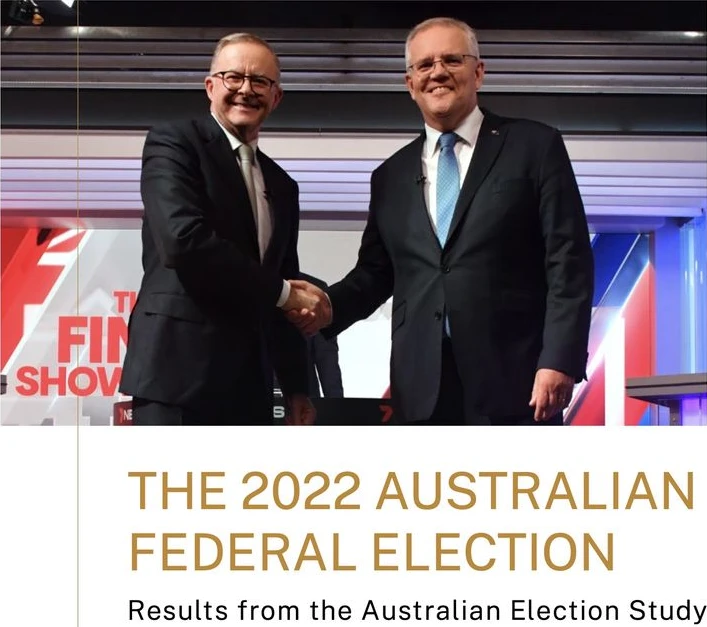
The 2022 Australian Federal Election: Results from the Australian Election Study
Launch of the 2022 Australian Election Study
Parliament House, Canberra
2022-12-05 9:30 AM - 11:00 AM
Sarah Cameron, Ian McAllister, Simon Jackman and Jill Sheppard
The Australian Election Study (AES) is a national survey of Australian voters conducted after each federal election. This talk will present the results from the 2022 AES, focusing on the key findings and implications for Australian politics.